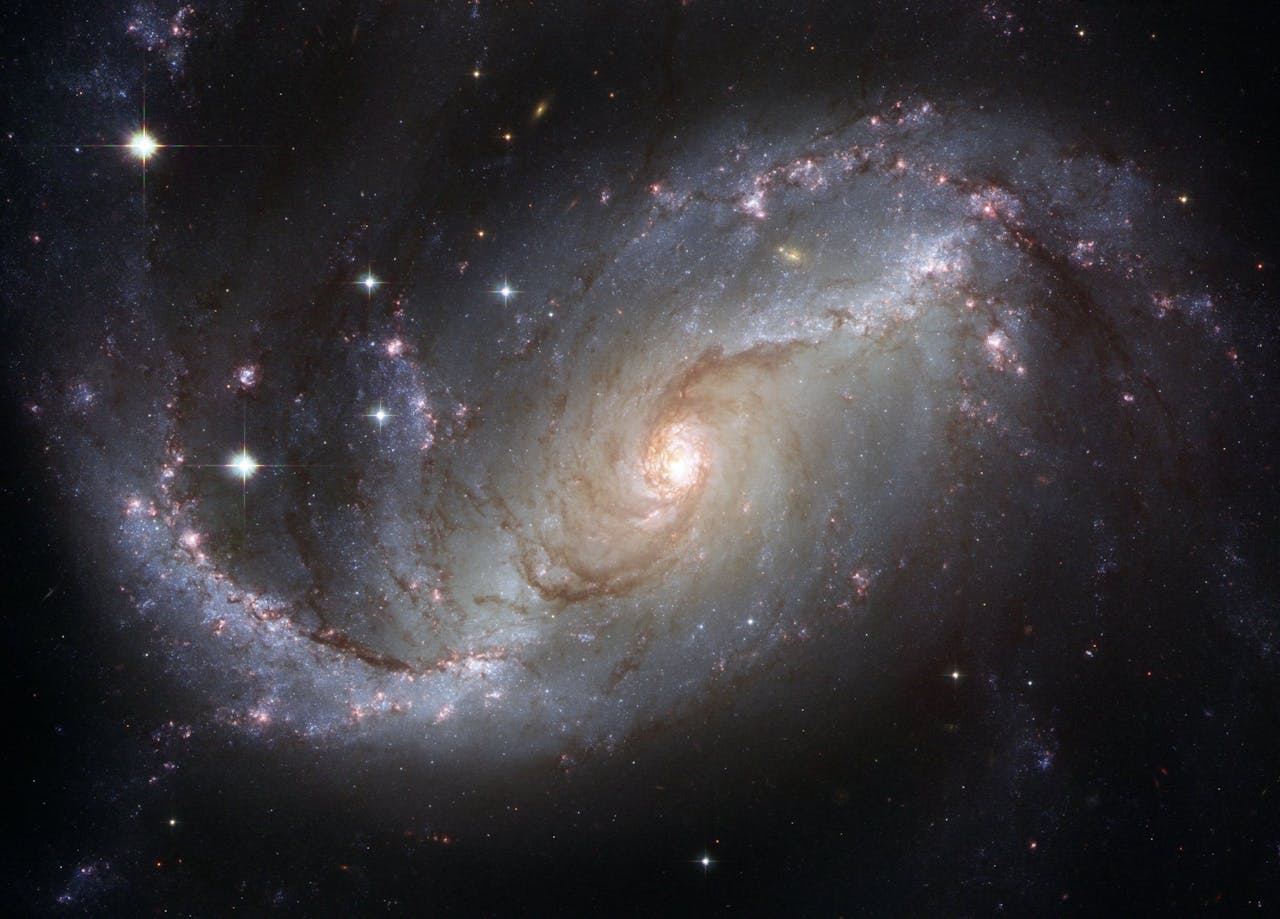
Light YearThe distance light travels in one year — about 9.46 trillion kilometres. Used to measure vast cosmic distances.OrbitThe curved path an object takes around a star, planet, or other body due to gravity. Earth orbits the Sun once every 365.25 days.GravityThe force that attracts objects with mass towards each other. It keeps planets in orbit and holds you on the ground.AtmosphereThe layer of gases surrounding a planet or moon, held in place by gravity. Earth's atmosphere protects us from harmful solar radiation.Solar SystemOur Sun and everything that orbits it — eight planets, dwarf planets, moons, asteroids, comets, and dust.GalaxyA massive system of stars, gas, dust, and dark matter bound together by gravity. Our Milky Way contains 100-400 billion stars.NebulaA giant cloud of gas and dust in space. Nebulae can be stellar nurseries where new stars are born, or the remnants of dead stars.SupernovaA powerful explosion that occurs when a massive star reaches the end of its life. Can briefly outshine an entire galaxy.Red ShiftThe stretching of light waves from objects moving away from us, shifting colours toward the red end of the spectrum. Shows the universe is expanding.ExoplanetA planet orbiting a star other than our Sun. Over 5,000 exoplanets have been confirmed, and billions more are estimated to exist in our galaxy.Astronomical Unit (AU)The average distance from the Earth to the Sun — about 150 million kilometres. Used to measure distances within the Solar System.Event HorizonThe boundary around a black hole beyond which nothing can escape — not even light. Once crossed, there is no return.Nuclear FusionThe process that powers stars — hydrogen atoms combine to form helium, releasing enormous amounts of energy.Accretion DiscA disc of gas and dust spiralling into a massive object like a black hole or forming star. Friction heats the material to extreme temperatures.HeliosphereThe vast bubble of charged particles surrounding the Sun, extending far beyond Pluto, protecting the Solar System from interstellar radiation.Space-TimeThe four-dimensional fabric of the universe (three dimensions of space plus time) described by Einstein's theory of general relativity.ConstellationA pattern of stars visible from Earth that ancient civilisations named after mythological figures, animals, or objects. There are 88 official constellations.SatelliteAny object orbiting another object. Moons are natural satellites; ISRO's spacecraft are artificial satellites. India has launched over 400 satellites.EquinoxThe two days each year (around March 20 and September 22) when day and night are nearly equal in length everywhere on Earth.ParsecA unit of distance equal to about 3.26 light-years. Used by astronomers for measuring distances to stars and galaxies.